Loading blog posts...
October 23, 2026 • 4 min read
When millions of Americans visit a clinic or hospital for routine bloodwork or specialized genetic screening, there is a strong chance their specimens end up at Quest Diagnostics (NYSE: DGX). Operating as one of the premier clinical laboratory networks in the United States alongside primary rival Labcorp, Quest is a bellwether for broader healthcare utilization. Today, our goal is to dig into the income statement from the company’s Q3 2026 10-Q filing to see how the business is performing and what insights we can extract from its latest quarterly numbers.
For the third quarter ended September 30, 2026, Quest Diagnostics generated $3.10 billion in total net revenues, marking a 10.0% increase compared to the $2.82 billion recorded in the third quarter of 2025.
Quest divides its operations into two primary segments:
Beneath the surface of the DIS segment's 10.2% revenue growth lies a notable operational dynamic. Total testing volume—measured by requisitions (individual testing orders)—surged by 14.5% year-over-year, driven almost entirely by organic requisition volume growth of 14.4%. However, revenue per requisition declined by 4.2% over the same period. In short, Quest processed significantly more lab orders at a slightly lower average price per order, reflecting shifts in test mix and payer dynamics, yet still came out well ahead on the top line.
Looking at who actually pays the bills within the DIS business, healthcare insurers accounted for 37% of Q3 net revenue, client payers (such as hospitals and other labs) made up 33%, government payers like Medicare and Medicaid represented 16%, and patients paying out-of-pocket (including deductibles and coinsurance) accounted for 12%.
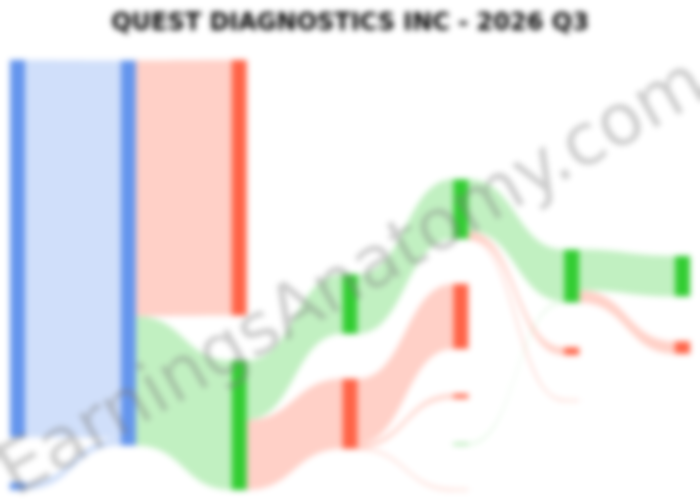
The diagram above maps out how Quest’s $3.10 billion in quarterly revenue flowed through its expense structure down to the bottom line.
The largest single expense is Cost of Services—the direct cost of obtaining, transporting, and testing specimens, as well as running lab facilities—which rose 10.1% year-over-year to $2.06 billion. That left a gross profit of $1.04 billion, or a 33.7% gross margin.
Where Quest really shined in Q3 was in controlling its overhead. Selling, General, and Administrative (SG&A) expenses grew by just 4.3% to $523 million (helped in part by $6 million in insurance recoveries for legal matters). Because SG&A grew much slower than the 10% top-line expansion, SG&A shrunk from 17.8% of revenue in Q3 2025 down to 16.9% in Q3 2026. Factoring in $37 million for the amortization of intangible assets and $3 million in net other operating expenses, total operating expenses landed at $563 million.
This operational discipline translated into a 24.2% jump in Operating Income, which reached $479 million (expanding operating margins by 180 basis points to 15.5%). After accounting for $61 million in net interest expense, $99 million in income taxes, and $9 million in after-tax earnings from equity method investees, consolidated net income hit $326 million. Subtracting $14 million attributable to noncontrolling interests (such as joint venture partners, including a notable venture with Corewell Health), net income attributable to Quest Diagnostics rose 27.6% to $312 million, or $2.78 per diluted share (up 28.7% from $2.16 a year ago).
Beyond the income statement, Quest’s balance sheet and cash flows reflect a mature, cash-generative business. Over the first nine months of 2026, the company generated $1.49 billion in operating cash flow, which easily funded $418 million in capital expenditures, $279 million in dividends, and $250 million in share repurchases (including $150 million bought back in September alone at an average price of $238.98 per share).
In the highly competitive diagnostic testing market, Quest Diagnostics and peers like Labcorp face a constant balancing act: offsetting reimbursement pressures and lower revenue per test with high-volume throughput and lab automation. Through its ongoing Invigorate cost-savings program and hospital lab outreach partnerships, Quest’s Q3 2026 results show that when specimen volumes are flowing at double-digit clips, the company’s fixed-cost lab network is well-positioned to convert top-line volume into outsized earnings growth.
Last updated: October 23, 2026