Loading blog posts...
August 2, 2026 • 3 min read
Digging into a company's income statement offers a clear window into its operational health and strategic trajectory. For Quanta Services (NYSE: PWR), a specialty contractor providing infrastructure solutions across the electric power, renewable energy, underground infrastructure, and communications sectors, examining their latest 10-Q filing reveals how effectively the firm is riding a multi-year power grid modernization wave. Competing alongside major industry players like MasTec, MYR Group, and Dycom Industries, Quanta serves as a key backbone for modernizing utility systems and building out critical tech-facility infrastructure.
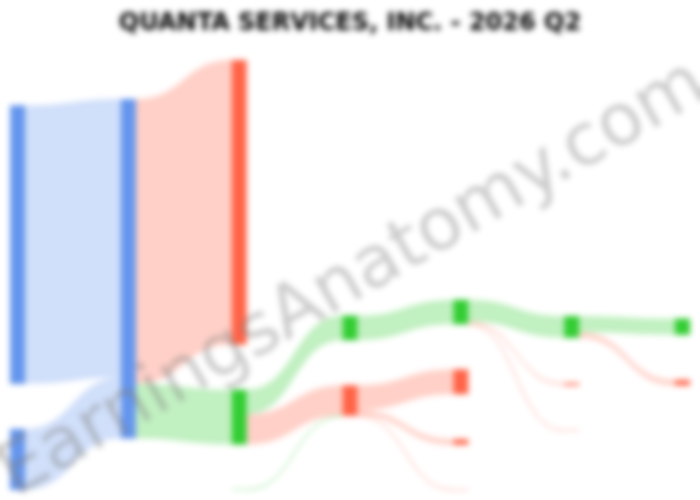
In the second quarter of 2026, Quanta achieved $9.56 billion in total revenue, marking a massive 41.1% surge from $6.77 billion in Q2 2025. The primary driver was the Electric segment—encompassing high-voltage transmission, distribution, and substation engineering—which generated $7.84 billion (up 43.6% year-over-year) and accounted for 82% of total revenue. This expansion reflects multi-year utility programs to upgrade grid reliability, connect renewable power sources, and support expanding electrical loads from artificial intelligence data centers and domestic manufacturing.
Meanwhile, the Underground and Infrastructure segment (focusing on gas utility, pipeline, and industrial facility systems) grew 30.7% to $1.72 billion. Inorganic growth played a substantial role here, with acquired businesses contributing approximately $355 million in quarterly revenue. A primary driver was Dynamic Systems (DSI), a turnkey mechanical and process infrastructure specialist acquired in mid-2025 to expand Quanta’s front-end plumbing and mechanical capabilities for high-tech facilities like data centers, semiconductor fabs, and healthcare hubs.
Quanta translated top-line growth into expanded margins across the board:
Quanta’s results also included $11.6 million from equity in earnings of integral unconsolidated affiliates. This line item represents net income from operational joint ventures, primarily LUMA Energy, LLC—a 50/50 joint venture with ATCO selected to operate, maintain, and modernize Puerto Rico's electric transmission and distribution system.
To balance project execution risks, Quanta utilizes a mix of contract types. While fixed-price contracts—where Quanta agrees to complete work for a set total price regardless of cost fluctuations—represented 63.7% of Q2 revenue, unit-price (18.5%) and cost-plus contracts (17.8%) help mitigate inflation and supply chain risks on larger or more variable jobs.
Quanta’s backlog—a non-GAAP measure estimating future revenues from signed contracts and anticipated master service agreement (MSA) work—surged to $53.4 billion as of June 30, 2026, up from $44.0 billion at year-end 2025. Approximately $32.3 billion of this total is expected to be realized within the next 12 months, providing strong revenue visibility.
However, executing on this volume presents non-trivial risks. The filing highlights an ongoing challenge across the specialty contracting space: intense competition for skilled unionized labor. Potential labor shortages could drive up wage costs or delay project milestones. Additionally, with over six in ten revenue dollars tied to fixed-price arrangements, unmitigated material inflation or schedule delays could squeeze operating margins. How effectively Quanta navigates these labor constraints relative to competitors like MasTec and MYR Group will be crucial to maintaining its margin momentum through the current infrastructure cycle.
Last updated: August 2, 2026
Explore prior quarterly filings, historical revenue breakdowns, and earnings trends.