Loading blog posts...
October 28, 2026 • 3 min read
NXP Semiconductors delivers the silicon brains behind modern vehicles, industrial machinery, smart devices, and cellular infrastructure. Headquartered in the Netherlands, NXP competes with global semiconductor giants like Infineon, STMicroelectronics, and Texas Instruments. Today, our goal is to dig into the income statement from NXP's latest 10-Q filing to see how the business is navigating the current semiconductor cycle and what lessons we can draw from its operational performance.
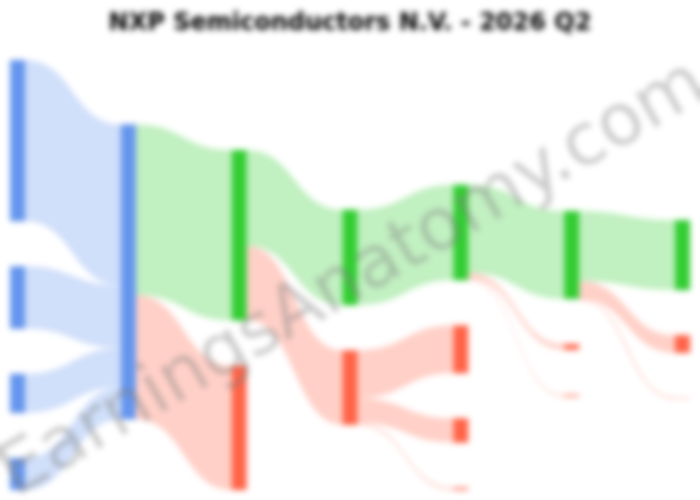
For the third quarter of 2026, NXP generated $3.79 billion in total revenue, marking an impressive 19.3% increase over the $3.17 billion recorded in the same period last year. Operating income climbed even faster, rising 37.5% year-over-year to $1.23 billion, lifting operating margin from 28.1% to 32.4%. Diluted earnings per share reached $3.48, compared to $2.48 in the prior-year period.
Growth was broad-based across end markets:
Geographically, momentum was led by the Americas (+28.2% to $1.18 billion) and China (+28.8% to $644 million), signaling an ongoing replenishment of channel inventories after previous destocking headwinds.
Gross margin widened to 57.8% from 56.3% a year ago, supported by improved fab utilization and product mix. Total operating expenses rose 7.4% to $958 million, primarily driven by performance-based compensation incentives ($39 million increase in R&D and $28 million in SG&A).
Below the operating line, net interest expense stood at $74 million ($108 million of interest expense against $34 million in interest income), while income taxes totaled $228 million at an effective tax rate of 20.2%, culminating in $899 million in net income ($884 million attributable to stockholders).
Free cash flow remained exceptionally robust, reaching $1.21 billion for the quarter ($1.26 billion in operating cash flow less $50 million in capital expenditures). This cash generation allowed NXP to return capital consistently, declaring its regular quarterly dividend of $1.014 per share while trimming net debt to $7.04 billion from $8.96 billion at year-end 2025.
Beyond quarterly operations, NXP is securing long-term capacity through joint ventures, including Singapore's VisionPower Semiconductor Manufacturing Company (VSMC) and Germany's European Semiconductor Manufacturing Company (ESMC). Under the VSMC agreement, NXP has committed to take-or-pay purchase obligations covering 80% to 90% of capacity—a total estimated commitment of $14.1 billion over 37 years.
While heavy long-term commitments and geopolitical export restrictions pose persistent challenges, NXP's strong pricing discipline and high-margin automotive footprint position it well against European and American peers as automotive and industrial silicon demand accelerates.
Last updated: October 28, 2026
Explore prior quarterly filings, historical revenue breakdowns, and earnings trends.
NXP Q2 2026: Revenue Up 19.5% as Auto Chip Cycle Turns, Margins Expand to 57.3%
Jul 29, 2026
Read
NXP Semiconductors Q1 2026: Broad Revenue Growth and a $621M Strategic Gain
May 1, 2026
Read
NXP Semiconductors 2025: Navigating the Cooling Chip Cycle
Feb 19, 2026
Read
NXP Q3 2025 Earnings: Automotive Strength Buffers Infrastructure Weakness
Oct 28, 2025
Read