Loading blog posts...
April 7, 2026 • 3 min read
Norfolk Southern Corporation (NSC), one of the premier Class I railroads in the United States, recently released its annual report. Operating roughly 19,100 route miles primarily in the East and Midwest, NSC is a critical artery for the U.S. economy, moving everything from coal and chemicals to automobiles.
Let’s unpack the numbers from their latest 10-K filing to see how the railroad navigated a complex 2025, characterized by flat revenues, significant operational shifts, and a massive strategic development on the horizon.
At first glance, the top-line numbers suggest a stagnant year. Total Railway Operating Revenues remained virtually unchanged at $12.18 billion, compared to $12.12 billion in 2024. However, the real story lies in the profitability and expense management. Despite flat revenue, Net Income jumped 10% to $2.87 billion, and Diluted Earnings Per Share (EPS) rose similarly to $12.75.
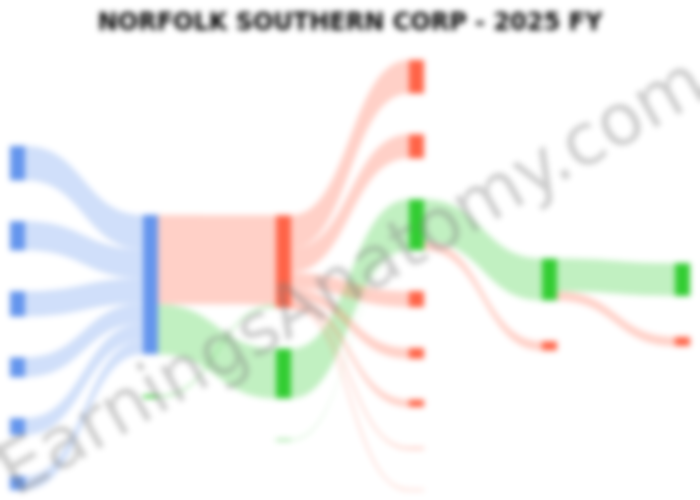
To visualize how revenue trickled down to the bottom line, take a look at the flow of their income statement below:
While the total revenue number was static, the composition of that revenue shifted, reflecting broader economic trends.
A major factor in NSC's 2025 financial performance involves the accounting for the "Eastern Ohio Incident" (the East Palestine derailment). In 2023 and 2024, this was a massive expense. However, in 2025, the line item for the incident shows a $(254) million figure—meaning it was a credit to expenses. This reflects insurance recoveries that exceeded the incremental costs recognized during the year.
This swing significantly helped the company's Operating Ratio (OR). The OR is a key efficiency metric for railroads, calculated as operating expenses divided by revenue (lower is better). NSC's GAAP Operating Ratio improved to 64.2% from 66.4% the previous year. Even when adjusting for the incident and merger costs, the adjusted OR improved to 65.0%.
Perhaps the most significant disclosure in the filing is the ongoing process regarding the Merger Agreement with Union Pacific, signed in July 2025. This consolidation would reshape the North American rail landscape, connecting NSC's eastern network with Union Pacific's massive western footprint.
The filing notes $80 million in merger-related expenses for 2025, covering retention agreements and legal fees. This strategic move introduces significant execution risk but also the potential for a seamless coast-to-coast rail network, a holy grail in logistics that could alter the competitive balance against trucking.
Norfolk Southern's 2025 was a year of financial recovery and strategic positioning. While volume growth was hard to come by—a challenge shared by peers like CSX and Canadian National—NSC managed to widen its profit margins through cost control and insurance recoveries.
Looking ahead, the narrative for Norfolk Southern will likely move away from recovery and toward integration. As they navigate the regulatory hurdles of the Union Pacific merger, investors will be watching to see if the company can maintain its improved operating ratio while merging two distinct corporate cultures and networks.
Last updated: April 7, 2026
Explore prior quarterly filings, historical revenue breakdowns, and earnings trends.
Norfolk Southern Q3 2026 Analysis: Pricing Power Offsets Operating Ratio Pressures
Oct 22, 2026
Read
Norfolk Southern Q2 2026: Revenue Up 11% as Union Pacific Merger Looms
Jul 26, 2026
Read
Norfolk Southern Q1 2026: Unpacking Merger Costs and Core Earnings
Apr 25, 2026
Read
Norfolk Southern Q3 2025: Core Strength Amid Merger Uncertainty
Oct 24, 2025
Read