Loading blog posts...
March 2, 2026 • 4 min read
When assessing the financial trajectory of a major travel operator, examining the income statement reveals far more than just ticket sales. Our goal today is to dig into the latest 10-K filing from Norwegian Cruise Line Holdings Ltd. (NCLH) to unpack the numbers, explore their cost management, and see what we can learn about their profitability heading into 2026. Operating three major brands—Norwegian Cruise Line, Oceania Cruises, and Regent Seven Seas Cruises—NCLH is continually expanding its global footprint.
NCLH brought in a massive $9.83 billion in total revenue in 2025, a solid 3.7% increase from 2024. This top-line growth was primarily driven by an increase in "Capacity Days"—a metric measuring available beds multiplied by cruise days—which rose to 24.4 million. This expansion was fueled by the delivery of two new ships: the Norwegian Aqua in March and the Oceania Allura in July.
Passenger ticket sales accounted for $6.69 billion of the pie, while onboard spending—think casinos, specialty dining, shore excursions, and spas—made up the remaining $3.14 billion. Occupancy remained incredibly strong at 103.5%. (In the cruise industry, occupancy can exceed 100% because the baseline assumes two passengers per cabin; any third or fourth guest pushes the metric higher).
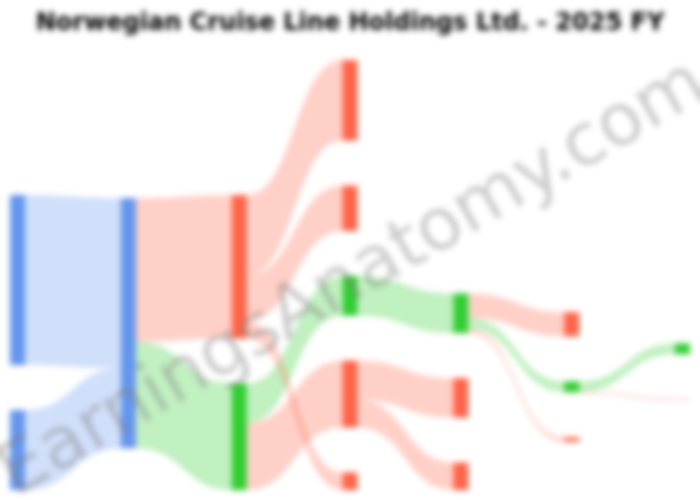
To better understand how NCLH's massive revenue streams translate into profits after covering the extensive costs of running a modern cruise fleet, the flow of revenue through the company's various costs and expenses to its net income is visualized in the diagram below.
Cruise lines have notoriously high fixed and variable costs, but NCLH showed strong operational discipline over the last year. Total cruise operating expenses actually dipped slightly to $5.64 billion (down 0.9% from 2024), aided by lower fuel costs and optimized airfare expenses.
However, other operating expenses—like marketing, general administration, and depreciation—rose 13% to $2.63 billion. A notable chunk of this increase came from a $95.1 million write-off of an internal software project, as well as higher depreciation from the newly delivered ships. Despite this write-off, NCLH generated a healthy $1.56 billion in operating income, up from $1.47 billion the year prior.
Here is where the income statement gets really interesting. While operating income grew, GAAP net income dropped by more than half—from $910.3 million in 2024 to $423.2 million in 2025. Several below-the-line, non-operating items dragged down the bottom line:
Moving forward, NCLH faces the dual challenge of managing its $13.7 billion in long-term debt while funding an ambitious expansion. With newly appointed CEO John W. Chidsey taking the helm in February 2026, the company is staring down a robust $20.4 billion newbuild pipeline—representing 13 ships on order through 2037. The true test over the next few years will be whether leadership can seamlessly translate this massive capacity expansion into sustainable, bottom-line profit.
Last updated: March 2, 2026