Loading blog posts...
May 4, 2026 • 3 min read
Welcome to our latest financial deep dive. Today, our goal is to dig into the income statement from Linde plc to see how the business is currently performing, what trends are driving its growth, and what we can learn from its financial mechanics.
For those unfamiliar, Linde is the undisputed heavyweight champion of the global industrial gas sector, commanding roughly a third of the market share. They produce and distribute essential atmospheric and process gases—like oxygen, nitrogen, helium, and hydrogen—to a diverse range of industries including healthcare, electronics, energy, and manufacturing. Let's unpack the numbers from their latest 10-Q filing to see how they navigated the first quarter of 2026.
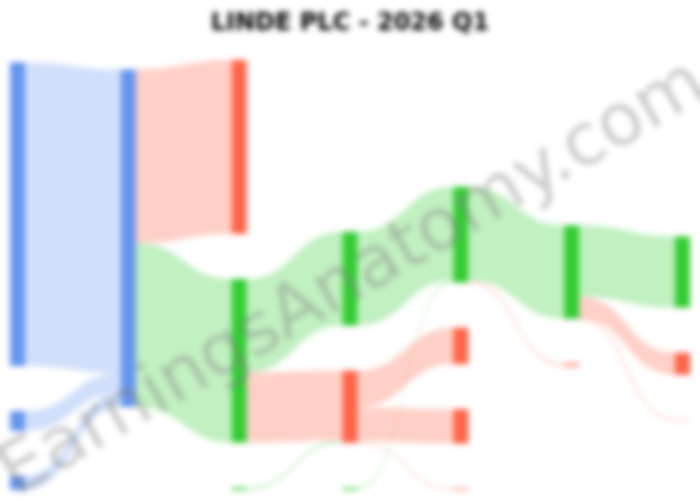
A company's income statement tells a story of how revenue is transformed into profit. The following flow diagram visualizes this journey for Linde's first quarter, showing how sales from its various divisions are offset by costs to arrive at the final net income.
Linde reported a solid start to the year with sales reaching $8.8 billion in the first quarter, an 8% increase from the $8.1 billion reported in the same period last year. A closer look at the drivers reveals a healthy mix of factors: underlying volumes grew by 1%, pricing contributed 2%, and favorable currency exchange rates provided a significant 5% tailwind.
More impressively, the company's profitability grew even faster than its revenue. Operating profit jumped 12% to $2.4 billion, pushing the operating margin up from 26.9% to 27.8%. This margin expansion suggests strong operational efficiency and pricing power, allowing Linde to convert more of its revenue into actual profit. This ultimately led to an 11% increase in net income, which stood at $1.9 billion.
Linde's performance highlights the strength of its core industrial gas business, which is divided into three geographic segments: Americas, EMEA (Europe, Middle East & Africa), and APAC (Asia-Pacific).
In contrast, the Engineering segment, which designs and builds gas processing plants, saw an 8% decline in revenue and an 11% drop in operating profit. While this segment is more cyclical and project-dependent, its downturn was more than offset by the robust and steady performance of the global industrial gas operations.
Linde's bottom-line performance translated into a 13% increase in diluted earnings per share (EPS), which rose to $3.98. This outsized growth in EPS was supported by the company's active share repurchase program. In the first quarter alone, Linde bought back over $800 million of its own shares. By reducing the number of shares outstanding, these buybacks increase the earnings attributable to each remaining share, directly enhancing shareholder value.
In conclusion, Linde's first-quarter results showcase a company firing on all cylinders in its core business. Strong pricing, favorable currency effects, and operational leverage drove impressive profit growth, while a strategic use of share buybacks amplified returns for investors. The performance demonstrates the resilience and strength of its industrial gas empire, even as its more volatile engineering arm faces headwinds.
Last updated: May 4, 2026
Explore prior quarterly filings, historical revenue breakdowns, and earnings trends.
Linde Q3 2026 Earnings: Sales Rise 9% as Charges Hit Reported Profit
Oct 30, 2026
Read
Linde Q2 2026: Sales Rise 9%, EPS Gains 11% as Backlog Reaches $8.1B
Aug 2, 2026
Read
Linde (LIN) 2025 10-K Analysis: Pricing Power in a Flat-Volume World
Feb 26, 2026
Read
Linde (LIN) Q3 2025 Earnings: Profitability Soars Despite Modest Sales Growth
Nov 4, 2025
Read