Loading blog posts...
July 27, 2026 • 4 min read
Kinder Morgan is one of North America’s largest energy infrastructure companies, moving and storing natural gas, refined products, crude oil, CO₂, and other fuels through pipelines, terminals, and related assets. The goal here is to dig into the income statement from Kinder Morgan’s latest 10-Q filing and see how the business is performing beneath the headline EPS number.
For Q2 2026, Kinder Morgan reported total revenue of $4.48 billion, up 11% from $4.04 billion a year earlier. Net income rose to $894 million, up 20% from $742 million, while net income attributable to Kinder Morgan increased 21% to $867 million. Basic and diluted EPS came in at $0.39, compared with $0.32 last year.
The margin profile was notable. Gross profit was $3.07 billion, implying a 68.6% gross margin, while operating income reached $1.35 billion, or a 30.1% operating margin. Net margin was a healthy 20.0%.
That improvement was not simply a revenue story. Operating income grew 17%, faster than revenue, even though costs of sales increased 16% to $1.41 billion. Operations and maintenance expense rose only 4% to $806 million, and depreciation, depletion and amortization was nearly flat at $620 million. In a pipeline and terminals business, where many costs are fixed or semi-fixed, modest cost growth can create meaningful earnings leverage when volumes, rates, or commodity-linked revenues improve.
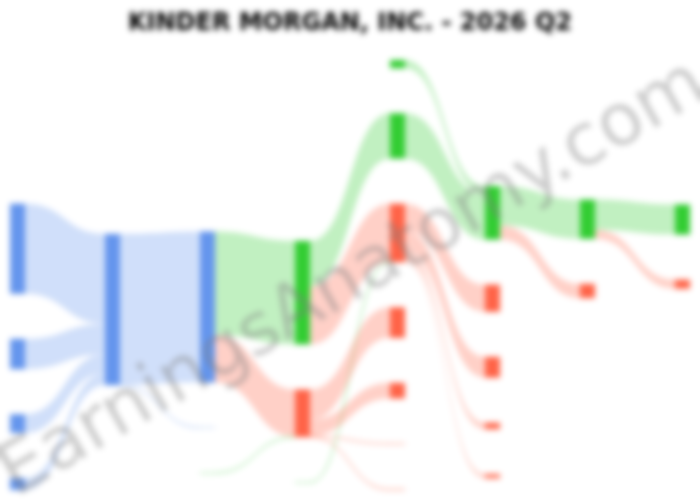
The flow diagram shows a small $9 million cost-of-revenue reconciliation adjustment between segment-level costs and consolidated costs. This is minor relative to Kinder Morgan’s $4.5 billion revenue base and does not change the overall picture.
Kinder Morgan’s largest segment, Natural Gas Pipelines, generated $2.67 billion of Q2 revenue, or about 60% of total company revenue. Segment EBDA — earnings before depreciation and amortization, a common infrastructure metric used to compare asset-level cash earnings — was $1.52 billion, up from $1.44 billion last year.
Volumes were also stronger. Natural gas transport volumes rose to 47,886 BBtu/d, up from 44,818 BBtu/d, while natural gas sales increased to 3,908 BBtu/d from 2,832 BBtu/d. This reinforces the importance of gas demand from LNG exports, power generation, industrial users, and local distribution customers.
The company also completed the $503 million Monument Pipeline system acquisition in May 2026. The acquired system includes roughly 225 miles of pipelines serving Houston and surrounding areas, with customers including gas utilities, LNG shippers, and industrial users. That acquisition fits squarely into Kinder Morgan’s natural gas infrastructure strategy.
The quarter was not only about natural gas. Products Pipelines revenue jumped to $902 million from $691 million, while segment EBDA rose 19% to $343 million, despite lower total delivery volumes of 2,044 MBbl/d versus 2,213 MBbl/d last year. That suggests pricing, mix, lower operating expenses, and activity such as blending helped offset weaker throughput.
Terminals revenue increased to $558 million, with segment EBDA up modestly to $310 million. Liquids utilization remained high at 93.0%, though slightly below 94.4% last year. CO₂ was the standout percentage grower: revenue rose to $355 million from $290 million, and segment EBDA increased to $226 million from $150 million, helped by higher oil production, stronger realized oil prices, and growth in Energy Transition Ventures, including renewable natural gas and RIN sales.
For the first six months of 2026, operating cash flow was $3.45 billion, up from $2.81 billion last year. Capital spending was also heavy: Kinder Morgan spent $1.79 billion on capital expenditures in the first half and expects $4.06 billion for the full year, including $3.12 billion of expansion capital.
Total debt stood at $32.14 billion, up slightly from $31.82 billion at year-end 2025. Current debt increased to $2.44 billion, reflecting upcoming maturities and commercial paper. Interest expense improved, however, with Q2 net interest expense falling to $425 million from $452 million.
Kinder Morgan declared a quarterly dividend of $0.2975 per share, up from $0.2925 last year, and expects $1.19 per share for 2026. The filing also notes that Moody’s upgraded the company’s long-term debt rating to Baa1 with a stable outlook in March 2026.
Kinder Morgan’s Q2 filing shows a stronger, broad-based quarter: higher revenue, improved operating income, rising EPS, and better cash generation. The business remains anchored by natural gas pipelines, but Products Pipelines, Terminals, and CO₂ all contributed. The main tradeoff is capital intensity — growth projects and acquisitions are requiring significant investment — but for now, the income statement shows a company converting infrastructure demand into higher earnings.
Last updated: July 27, 2026
Explore prior quarterly filings, historical revenue breakdowns, and earnings trends.
Kinder Morgan Q3 2026 Earnings: Inside KMI's Cash Flow & Segment Growth
Oct 23, 2026
Read
Pipeline to Profits: Kinder Morgan Q1 2026 Earnings Analysis
Apr 25, 2026
Read
Kinder Morgan 2025 10-K: Natural Gas Dominance & Financial Flows
Feb 19, 2026
Read
Kinder Morgan (KMI) Q3 2025 10-Q: Natural Gas Strength Amid Rising Costs
Oct 25, 2025
Read