Loading blog posts...
October 30, 2026 • 4 min read
Hyatt Hotels Corporation (NYSE: H) is a global hospitality leader with a portfolio spanning over 1,580 properties across luxury, lifestyle, select-service, and all-inclusive resort brands. Today, our goal is to dig into the income statement from Hyatt's third-quarter 2026 Form 10-Q to see how the business is performing and what we can learn about its ongoing shift toward an asset-light operating model.
In the third quarter ended September 30, 2026, Hyatt swung back to profitability, posting consolidated net income of $61 million (or $58 million, and $0.60 per diluted share, attributable to Hyatt), compared to a net loss of $50 million in Q3 2025. While total revenue ticked down slightly by 2.4% year-over-year to $1.74 billion, this top-line dip was largely an intentional byproduct of selling off owned real estate in favor of high-margin fee streams.
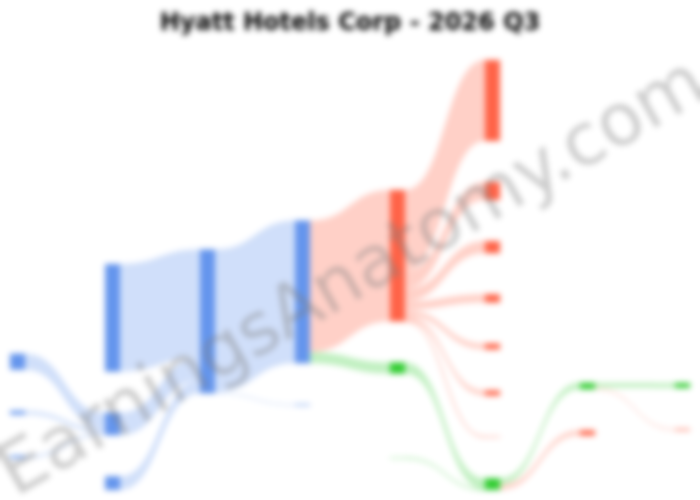
To understand Hyatt's income statement, it helps to look at how its three main operating segments—Management and Franchising, Owned and Leased, and Distribution—flow into the bottom line. The visual below maps out Hyatt's third-quarter revenue sources, expenses, and profitability:
A quick glance at the numbers reveals a massive line item: $995 million in revenues for reimbursed costs (within the Management and Franchising segment) and $988 million in corresponding reimbursed costs on the expense side. In the hotel industry, management and franchising companies pay for property-level payroll, marketing, and loyalty program operations on behalf of third-party hotel owners, who then reimburse them dollar-for-dollar. Because these pass-through funds yield virtually zero profit margin, analysts focus on Net Fees—which jumped 23.6% year-over-year to $309 million in Q3 2026.
Meanwhile, Owned and Leased segment revenue dropped 36.7% to $276 million ($271 million after intersegment eliminations), accompanied by a 35.9% drop in direct property expenses to $222 million. Following the acquisition of Playa Hotels in 2025, Hyatt subsequently sold off the underlying real estate portfolio (reducing its owned all-inclusive resort count from 23 properties a year ago to just 6) while retaining long-term management agreements.
Beyond the structural shift in revenue, underlying travel demand remained solid during the quarter:
On the expense side, total direct and general and administrative expenses fell from $1.69 billion to $1.54 billion, aided by the property divestitures and a drop in transaction and integration costs from $25 million to $8 million. However, operating profit was weighed down by $64 million in asset impairments (up from $9 million in Q3 2025). This charge primarily reflected $40 million in write-downs for management and franchise agreement intangibles due to contract terminations and pipeline hotels no longer expected to open, alongside a $20 million impairment on brand intangibles. Even with those charges, Hyatt generated $138 million in operating income (a 7.9% operating margin) and $295 million in Adjusted EBITDA (up 6.2% year-over-year).
By trading capital-intensive hotel ownership for recurring management and franchise fees, Hyatt is following a playbook similar to mega-peers Marriott International and Hilton Worldwide. The benefits of this strategy are visible in the company's expanding fee revenues, lower interest expense (down 27.5% to $65 million), and steady capital returns—including $294 million in share repurchases and $42 million in dividends over the first nine months of 2026. Moving forward, investors will be watching whether Hyatt can sustain its strong US and Asian RevPAR momentum while navigating softer occupancy trends in its Americas all-inclusive resort portfolio and keeping pipeline attrition in check.
Last updated: October 30, 2026
Explore prior quarterly filings, historical revenue breakdowns, and earnings trends.