Loading blog posts...
October 29, 2026 • 3 min read
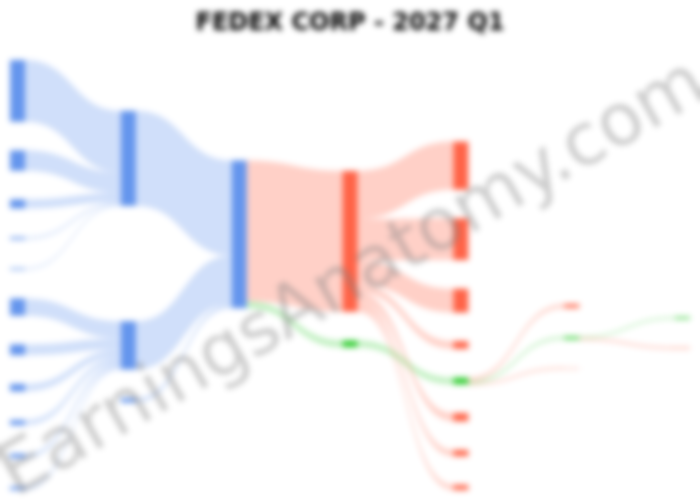
Examining an income statement often reveals far more than top-line growth or bottom-line beats; it unpacks how a company's operational engine navigates shifting market dynamics and structural changes. Digging into the numbers from FedEx Corp.’s latest 10-Q filing for the quarter ended September 30, 2026, reveals a period of significant corporate evolution, marked by steady operational delivery alongside dramatic paper swings below the operating line.
The unallocated revenue of $680 million shown alongside the core logistics network represents complementary non-transportation units, including FedEx Office, FedEx Dataworks, and FedEx Supply Chain (which the company agreed to sell to CMA CGM for $1.4 billion).
FedEx posted total consolidated revenue of $22.86 billion for the quarter, an increase of 12% compared to $20.43 billion in the prior-year period. Total operating income rose 10% to $1.07 billion from $972 million, keeping consolidated operating margins relatively steady at 4.7%.
Following the operational restructuring that accompanied the separation of its freight division, FedEx now reports its primary business under two main segments:
These top-line improvements helped cushion noticeable cost pressures. Operating expenses totaled $21.79 billion, lifted by a 19% increase in purchased transportation (to $6.46 billion) and a 64% jump in fuel costs to $1.27 billion, driven by higher fuel prices and operational utilization.
Despite the 10% rise in operating income, net income fell by 55% from continuing operations to $290 million ($1.21 per diluted share), down from $645 million ($2.73 per share) in the prior-year period.
This bottom-line contraction was largely driven by a $1.24 billion mark-to-market loss on short-term investments. On June 1, 2026, FedEx completed the tax-free spin-off of FedEx Freight into a separate, publicly traded company. FedEx retained a 19.9% equity stake in the newly public business. Under standard GAAP rules, retained holdings in publicly traded equity securities must be adjusted to fair value every quarter through the income statement. Consequently, volatility in FedEx Freight’s public share price directly impacts FedEx's reported quarterly earnings, even though it represents an unrealized accounting adjustment rather than an operational cash drain.
FedEx also deployed capital strategically during the period, investing $2.50 billion for a 37% stake in European automated parcel locker specialist InPost, strengthening its last-mile footprint across the continent.
As global parcel and freight volumes adjust to shifting trade policies and consumer habits, FedEx faces stiff rivalry from United States Postal Service changes, United Parcel Service (UPS), and Amazon’s growing internal logistics footprint, as well as European regional carriers. To protect margins against labor rate increases and elevated fuel costs, the carrier recently announced an average 5.9% shipping rate hike taking effect in January 2027. Moving forward, managing network utilization through its combined express-ground operations while navigating non-operating equity volatility will remain central to sustaining profitable growth.
Last updated: October 29, 2026
Explore prior quarterly filings, historical revenue breakdowns, and earnings trends.
FedEx FY26 Financial Deep Dive: Network 2.0 and Freight Spin-Off
Jul 21, 2026
Read
FedEx Q3 2026 Earnings: Core Growth and Freight Spin-Off Analysis
Mar 21, 2026
Read
FedEx Q2 2026: "One FedEx" Delivers Profits as Freight Prepares to Spin
Dec 19, 2025
Read
FedEx FY2025 10-K: Stable Revenue Amid a Push for Efficiency
Jul 22, 2025
Read