Loading blog posts...
October 23, 2026 • 3 min read
Online lending specialist Enova International recently crossed an important milestone: quarterly revenue surpassed $1 billion for the first time. To evaluate how efficiently that top line converted into bottom-line profit, we can dig directly into the numbers from their latest 10-Q filing. Beyond the headline numbers, the company's financial statements offer valuable insight into portfolio credit performance, operating leverage, and strategic positioning.
Unlike traditional commercial banks that fund loans via low-cost retail deposits and maintain loan loss allowances under CECL accounting, Enova uses fair value accounting for its loan portfolio. This means loan charge-offs and fair value adjustments are grouped together directly on the income statement under Change in Fair Value.
Effectively, this line functions as Enova’s cost of revenue: subtracting fair value adjustments from gross revenue yields Net Revenue, which serves as the company's gross profit.
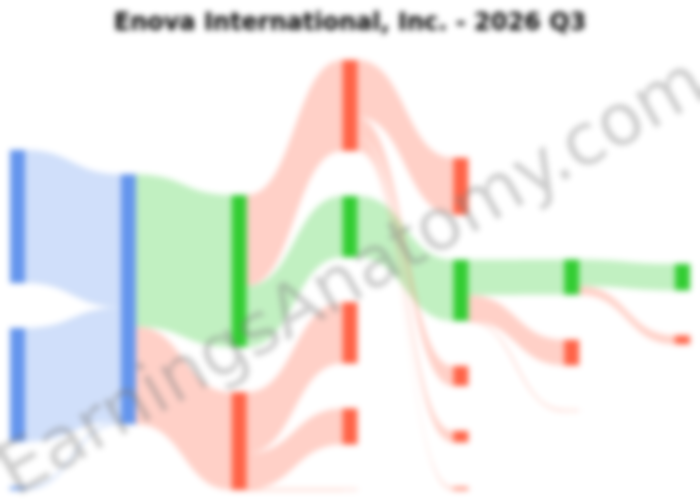
In the quarterly flow above, consolidated Change in Fair Value came to $394.8 million against $1,009.2 million in total revenue, producing $614.4 million in net revenue (a 60.9% net revenue margin). A tiny residual of $2.0 million in fair value adjustments remains unallocated at the corporate level, with the rest split between consumer and small business portfolios.
Enova serves non-prime consumers and small businesses through automated online platforms. Its consumer branch operates through well-known digital storefronts like CashNetUSA and NetCredit, while small business credit is delivered primarily through OnDeck (acquired in 2020) and Headway Capital.
Total operating expenses grew 39.1% year-over-year to $367.1 million, propelled primarily by aggressive customer acquisition. Marketing spend increased to $229.7 million from $147.4 million in Q3 2025 as Enova leaned into strong borrower demand.
Despite heavier marketing investments and a rise in net interest expense to $103.5 million to support its $5.4 billion debt stack, operating leverage held firm:
Enova’s Q3 demonstrates the scalability of its automated risk-scoring models across fragmented credit niches. However, the company faces evolving challenges. Enova recently terminated its planned acquisition of digital bank Grasshopper Bancorp—incurring $5.5 million in transaction costs year-to-date and a subsequent $4.0 million mutual termination payment.
Without a chartered bank deposit base, Enova must continue relying on asset-backed securitization facilities and corporate debt to fund its loan book. As peers like OneMain Financial and Upstart navigate similar macroeconomic uncertainties, interest rate shifts, and tightening regulatory scrutiny, Enova's ability to maintain underwriting discipline while handling higher funding costs will dictate its next phase of growth.
Last updated: October 23, 2026
Explore prior quarterly filings, historical revenue breakdowns, and earnings trends.