Loading blog posts...
October 30, 2026 • 3 min read
Eli Lilly’s third-quarter income statement shows rapid sales growth—but a much smaller increase in profit as spending on acquired drug research surged. Digging into its Q3 2026 10-Q helps explain that gap and what it reveals about the pharmaceutical company’s business: diabetes and obesity medicines are funding substantial investment in its next generation of treatments.
Revenue reached $24.4 billion, up 39% from a year earlier. Net income rose 16% to $6.45 billion, while diluted earnings per share increased to $7.22 from $6.21.
Lilly sells treatments across diabetes, obesity, cancer, immunology, and neuroscience, but its growth remains heavily concentrated in two tirzepatide brands:
Together, they generated 66% of total revenue, versus 57% a year earlier. Their combined $6.0 billion sales increase accounted for approximately 88% of Lilly’s overall revenue increase.
That concentration matters. Oncology revenue grew a more modest 8% to $2.6 billion, while Trulicity and Taltz sales declined 14% and 5%, respectively.
International expansion also stood out. Revenue outside the U.S. rose 47% to $9.26 billion, outpacing 34% U.S. growth. Mounjaro alone generated $5.73 billion outside the U.S.—more than its domestic sales.
However, growth came despite considerable pricing pressure. Lilly’s revenue bridge attributes 53 percentage points of growth to volume, offset by a 15-point drag from price, with rounding affecting the reported total. Outside the U.S., the price drag reached 29 points. The central takeaway: Lilly is expanding sales through volume, not higher realized prices.
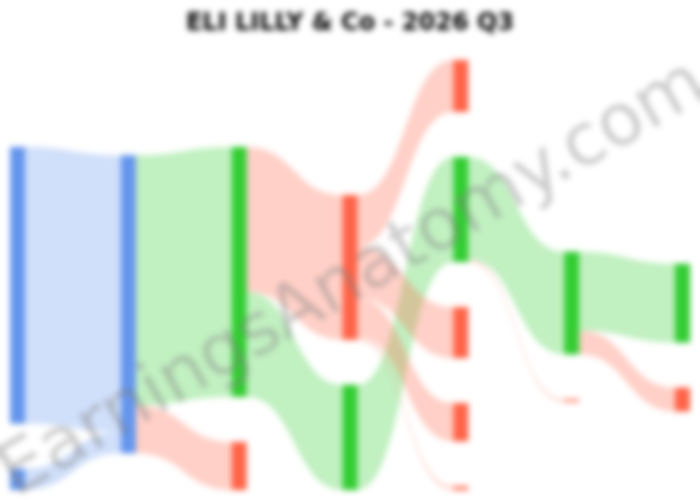
The quarterly revenue-to-profit flow shows where the money went:
Gross profit increased 40% to $20.46 billion, and gross margin improved to 83.9% from 82.9%. Routine research and development rose 23% to $4.25 billion, while marketing, selling, and administrative expenses increased 14% to $3.13 billion—both slower than revenue.
The major difference was acquired in-process research and development, which jumped to $4.18 billion from $656 million. These are charges for purchased research programs that have not yet become approved products.
Two transactions explain most of that expense:
Calculated operating income rose approximately 17% to $8.61 billion, but operating margin fell to 35.3% from 41.8%. Acquired research charges alone absorbed 17% of quarterly revenue. Thus, slower profit growth does not reflect deteriorating gross margins; it primarily reflects a much larger expense for purchasing future pipeline opportunities.
For the first nine months, operating cash flow reached $27.42 billion, roughly double the prior year. Yet investing outflows totaled $27.61 billion, including acquisitions, purchased research, and $8.44 billion of capital spending. Debt increased $7.0 billion to $49.5 billion.
Lilly’s results show a highly profitable business reinvesting aggressively. In competition with companies such as Novo Nordisk, the key issues are increasingly volume, access, and pipeline execution. With two medicines supplying two-thirds of revenue, pricing pressure and product concentration remain important counterweights to impressive growth.
Last updated: October 30, 2026
Explore prior quarterly filings, historical revenue breakdowns, and earnings trends.
Eli Lilly Q2 2026: Mounjaro and Zepbound Drive 48% Revenue Growth
Aug 16, 2026
Read
Eli Lilly Q1 2026 Analysis: Mounjaro and Zepbound Drive Record Growth
Apr 30, 2026
Read
Eli Lilly 10-K Analysis: Inside the $65 Billion Cardiometabolic Surge
Feb 17, 2026
Read
Eli Lilly Q3 2025: Mounjaro & Zepbound Fuel 54% Revenue Surge
Oct 30, 2025
Read