Loading blog posts...
May 11, 2026 • 4 min read
Coinbase Global, Inc. (COIN) is one of the world's most recognizable cryptocurrency exchange platforms, providing the critical infrastructure for both everyday retail consumers and massive institutional players to trade, stake, and store digital assets. In a quarter marked by a tough industry-wide crypto slump, we want to dig into their income statement to see how their core business is holding up and what we can learn about their ongoing shift toward more stable revenue streams.
Let's unpack the numbers from their latest 10-Q filing to see how the company navigated a challenging start to 2026.
The first quarter of 2026 was unforgiving for the broader cryptocurrency market, with major assets like Bitcoin and Ethereum seeing significant double-digit price declines. This macro environment directly impacted Coinbase’s platform activity: Total Trading Volume plummeted by 50% year-over-year, dropping from $401 billion in Q1 2025 to $202 billion. Retail volume took the hardest hit, cratering by 54%.
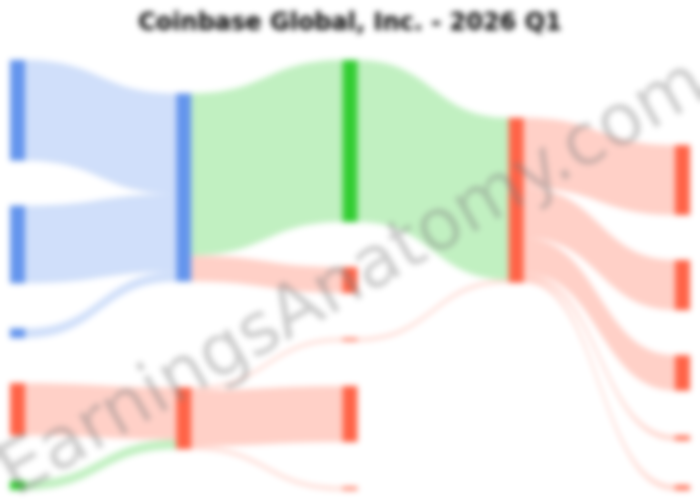
Consequently, Coinbase's total net revenue fell to $1.34 billion, with core transaction revenue down 40% year-over-year to $755.8 million.
However, there was a fascinating silver lining. While consumer transaction revenue dropped sharply, institutional transaction revenue actually grew 37% to $135.7 million. This was almost entirely driven by Coinbase's blockbuster $4.3 billion acquisition of Deribit—the world's leading crypto options exchange—in August 2025. By integrating Deribit, Coinbase unlocked $68.5 million in new derivatives trading revenue, cushioning the blow from the massive drop in traditional spot market volume.
For years, Coinbase has been trying to diversify its income away from highly cyclical trading fees. Their "Subscription and services" segment—which brought in $583.5 million this quarter—is the key to that strategy.
A major bright spot was Stablecoin revenue, which rose 11% to $305.4 million. Stablecoins are cryptocurrencies pegged to fiat currencies like the US Dollar (such as USDC). Coinbase earns interest on the fiat reserves backing these tokens. Despite average interest rates declining by 67 basis points during the quarter, the sheer volume of USDC balances held by customers on the platform surged, driving revenue upward.
On the flip side, blockchain rewards (revenue earned by staking crypto assets to validate blockchain networks) dropped 49% to $100.8 million. This decline was primarily driven by lower asset prices across the board, particularly Solana, and reduced network reward rates.
The broader market sell-off didn't just suppress trading volumes; it took a direct toll on Coinbase's own balance sheet.
Because Coinbase holds a sizable treasury of digital assets, they are required to mark those assets to market prices. With the crypto market pulling back, Coinbase recorded a staggering $482.4 million net loss on crypto assets held for investment. This massive non-cash hit was the primary driver pushing the company into an operating loss of $21.4 million and an ultimate net loss of $394.1 million for the quarter (a stark contrast to their $65.6 million net income in Q1 2025).
If we strip out these non-cash investment losses, taxes, and stock-based compensation, their Adjusted EBITDA (Earnings Before Interest, Taxes, Depreciation, and Amortization) remained comfortably positive at $303.3 million, though still down 67% from the prior year.
Coinbase's Q1 2026 results highlight the double-edged sword of operating a crypto exchange. When the market slumps, Monthly Transacting Users (MTUs) inevitably fall—down 15% to 8.2 million this quarter—and corporate crypto treasuries bleed.
Yet, compared to legacy competitors, Coinbase is aggressively building a more diversified foundation. Their expansion into institutional derivatives via Deribit and the resilient growth of their USDC stablecoin ecosystem show that the company is finding new ways to generate revenue, ensuring they remain firmly entrenched as the market leader even during crypto winters.
Last updated: May 11, 2026