Loading blog posts...
October 29, 2026 • 4 min read
The Coca-Cola Company (NYSE: KO) just released its Q3 2026 10-Q filing for the period ended October 2, 2026. The goal here is to dig into the income statement and segment disclosures from this latest quarterly report to see how the beverage giant's business is performing and what insights we can learn from the numbers. Between strong global volume growth and impressive margin expansion, Coca-Cola delivered a solid third quarter.
For the third quarter of 2026, Coca-Cola generated $13.38 billion in net operating revenues, a 7.4% increase from the $12.46 billion reported in the same period last year. Rather than relying solely on price hikes, this top-line growth was primarily driven by a 7% jump in concentrate sales volume and a 5% increase in worldwide unit case volume—which measures 24 eight-ounce servings of finished beverages—alongside a 1% benefit from price/mix (a metric capturing both direct price changes and shifts in the types of products or package sizes sold).
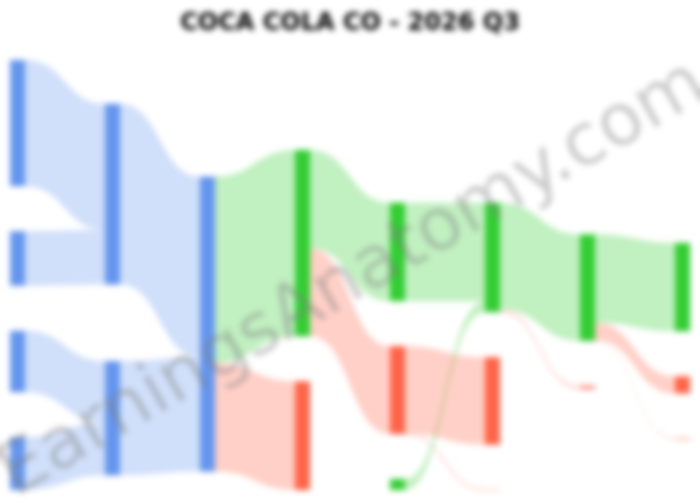
The visual flow below breaks down how Coca-Cola's Q3 revenue moved from its core business lines down to the bottom line:
Coca-Cola operates through two primary revenue models: Concentrate operations ($8.20 billion, or 61% of total revenue) and Finished product operations ($5.18 billion, or 39%). In its concentrate business, the company sells syrups, concentrates, and beverage bases to authorized bottling partners who then combine them with sweeteners and carbonated water to sell to retailers. In its finished product operations, Coca-Cola manufactures and sells the ready-to-drink beverages directly through its own company-owned bottling and distribution operations.
Because selling syrup is far less capital- and material-intensive than bottling and shipping liquids, this 61/39 business mix allows Coca-Cola to maintain enviable profitability:
Looking at Coca-Cola's geographic operating segments, growth was led by emerging and international markets:
Beyond the quarterly income statement, the nine-month cash flow statement reveals a dramatic jump in operating cash flow—from $3.65 billion in the first nine months of 2025 to $12.47 billion in 2026. This $8.8 billion swing occurred because prior-year cash flows were heavily depressed by working capital outflows (including tax litigation deposits). Meanwhile, the company continues to contest its long-running transfer pricing dispute with the IRS regarding tax years 2007 through 2009.
Coca-Cola's Q3 2026 results highlight the resilience of its asset-light concentrate model. Even with flat unit case volume in North America, the company's deep footprint in high-growth regions like Latin America, India, and Asia Pacific is driving real volume expansion rather than just inflation-driven pricing. With operating margins exceeding 33% and $13.69 billion in cash and short-term investments on the balance sheet, Coca-Cola remains well-positioned to fund its hefty dividend ($6.84 billion paid year-to-date) while navigating global currency shifts and ongoing tax litigation.
Last updated: October 29, 2026
Explore prior quarterly filings, historical revenue breakdowns, and earnings trends.
Coca-Cola Q2 2026: Margin Expansion and $14 Billion IRS Tax Risk
Jul 31, 2026
Read
Coca-Cola (KO) Q1 2026 Earnings Analysis: Margin Expansion
May 1, 2026
Read
Coca-Cola 2025 Financials: How Pricing Power Drove $13B in Profit
Feb 23, 2026
Read
Coca-Cola Q3 2025 Analysis: Profit Soars 59% on Pricing Power
Oct 23, 2025
Read