Loading blog posts...
August 2, 2026 • 4 min read
Chubb Limited is the world's largest publicly traded property and casualty insurer — a Zurich-domiciled, NYSE-listed group that writes everything from Fortune 500 commercial casualty and high-net-worth homeowners policies to U.S. crop insurance and Asian life products. Its second-quarter 10-Q offers a useful case study in how an insurer can improve its core business and still report lower profits. Let's unpack the income statement to see what actually moved.
Total revenues reached $15.82 billion, up from $14.84 billion a year ago, powered by net premiums earned of $13.89 billion (+5.8%) and net investment income of $1.76 billion (+12.3%) on a growing $172.6 billion portfolio. Yet net income attributable to Chubb slipped to $2.85 billion from $2.97 billion, and diluted EPS eased to $7.30 from $7.35.
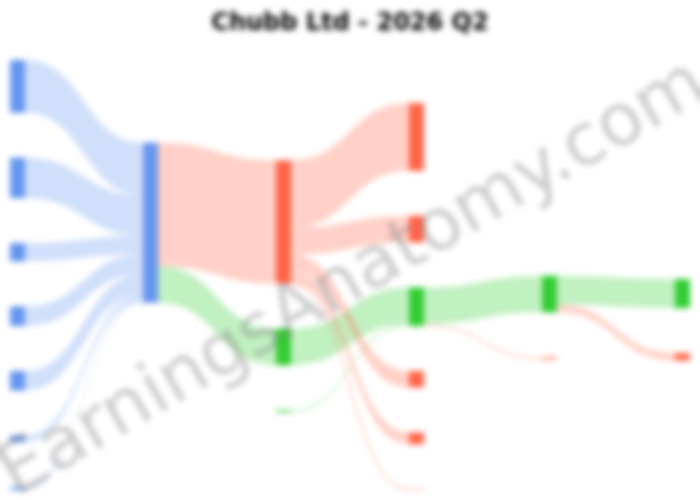
The $1.93 billion of revenue not tied to any segment in the flow above is simply investment-related income — net investment income, net realized gains of $162 million, and small market risk benefit gains — which Chubb reports at the consolidated level rather than allocating to underwriting units.
The culprit for the earnings dip sits in one line: "Other (income) expense" contributed just $196 million versus $655 million last year, a $459 million swing. Inside it, "equity in net income of partially-owned entities" collapsed from $657 million to $124 million. This is Chubb's $17.4 billion book of private equity fund holdings (buyout, real assets, distressed and private credit strategies), where positions over 3% ownership are marked through earnings. Pre-tax mark-to-market gains on private equity were $99 million this quarter versus $512 million a year ago — a reminder that reported insurance earnings increasingly ride on private-market valuations.
The P&C combined ratio — losses plus expenses as a percentage of premiums, where under 100% means profit — improved to 83.8% from 85.6%. But the current accident year ratio excluding catastrophes was essentially unchanged at 82.2% vs 82.3%. The gain came from lower catastrophe losses ($475 million vs $630 million) and larger favorable prior-period reserve releases ($283 million vs $249 million).
Beneath that, the segments diverged sharply:
One less pleasant line: corporate adverse development for molestation-related claims rose to $158 million from $70 million, an ongoing legacy drag.
Chubb repurchased 2.99 million shares for $979 million in the quarter ($2.12 billion year to date), pulling the diluted share count down 3.1% year over year — which is why EPS fell only 0.7% while dollar earnings dropped 3.8%. The board's prior authorization was fully exhausted at quarter-end, with $7.5 billion newly available in July. Financing was busy too: Chubb repaid $1.5 billion of 3.35% notes and issued renminbi, Canadian dollar, Swiss franc and U.S. dollar debt, lifting long-term debt to $17.5 billion while keeping leverage at a modest 18.6% of adjusted capitalization.
For the first half, net income is up 20.4% to $5.17 billion — flattered by last year's $1.47 billion California wildfire hit. The real story is a disciplined underwriter deliberately ceding share in softening property and financial lines while leaning on international, middle-market and life growth. With rivals like AIG, Travelers, Zurich and the Lloyd's market competing hard on price, Chubb's willingness to shrink premium rather than chase inadequate rates is the strategic bet worth watching — as is its growing dependence on investment and private-equity income to fill the earnings gap.
Last updated: August 2, 2026
Explore prior quarterly filings, historical revenue breakdowns, and earnings trends.