Loading blog posts...
October 30, 2026 • 4 min read
Fast-casual restaurant giant Chipotle Mexican Grill, Inc. (NYSE: CMG) just released its financial results for the third quarter ended September 30, 2026. Today, we are going to dig into the income statement from the company's latest 10-Q filing to see how things are going across its restaurant network and what we can learn about its current operational efficiency and profitability.
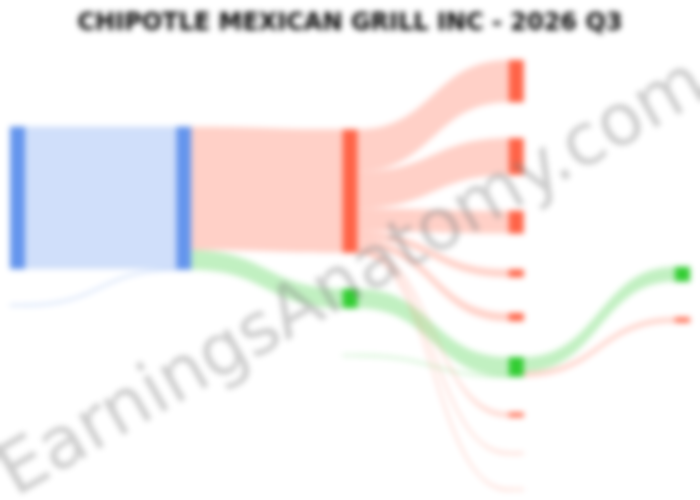
In Q3 2026, Chipotle demonstrated solid top-line momentum, pushing quarterly revenue up 9.6% year-over-year to $3.29 billion. However, rising labor, marketing, and corporate costs outpaced those sales gains, pulling net income down 11.1% to $339.9 million, or $0.27 per diluted share (compared to $0.29 in Q3 2025).
Chipotle’s revenue comes almost entirely from restaurant food and beverage sales ($3.28 billion), supplemented by a small stream of delivery service revenue ($15.2 million). Two main engines drove the $289.7 million year-over-year revenue increase: aggressive store expansion and steady performance at existing locations.
During the third quarter, Chipotle opened 84 new company-owned restaurants—53 of which featured a Chipotlane, the brand's drive-thru digital order pickup lane. This brought the total company-owned footprint to 4,267 locations, alongside 20 international partner-operated restaurants. Non-comparable new restaurants opened in 2025 and 2026 contributed roughly $235.4 million in incremental sales during the quarter.
Meanwhile, comparable restaurant sales—a vital retail metric measuring revenue growth at restaurants open for at least 12 full calendar months—increased 2.1% year-over-year. This growth was balanced between a 0.8% uptick in customer foot traffic (transactions) and a 1.3% increase in the average check (the average amount spent per order). Notably, while menu price increases boosted the average check by 2.7%, this was partially offset by a 1.4% decline in check mix, meaning customers slightly scaled back on extra add-ons or smaller group orders.
While top-line growth remained healthy, the cost side of the income statement explains why operating income dipped 5.3% year-over-year to $452.0 million (an operating margin of 13.7%).
Interestingly, ingredient inflation was not the culprit. Food, beverage, and packaging costs actually improved as a percentage of total revenue, dropping 50 basis points to 29.5% ($972.4 million). Instead, the pressure came from store-level labor, marketing, and corporate overhead:
Looking at geographic performance, Chipotle's core U.S. segment generated $3.21 billion in revenue and $639.0 million in segment operating income (a 19.9% margin). Its growing international operations—spanning Canada, Europe, and partner-operated stores—generated $81.2 million in revenue and $5.4 million in operating profit, nearly doubling its operating profit contribution from a year ago.
Another subtle takeaway from the bottom half of the income statement is the sharp drop in interest and other income, which fell 73.9% from $19.8 million in Q3 2025 to $5.2 million in Q3 2026. Over the first nine months of 2026, Chipotle funded $1.46 billion in common stock repurchases and $640.6 million in capital expenditures (mostly new store builds), largely by letting $526.9 million in U.S. Treasury and investment holdings mature. A smaller investment portfolio naturally yielded less interest income, which—combined with a higher effective tax rate of 25.6% (up from 23.1%)—further weighed on net income.
Chipotle's Q3 2026 filing highlights the broader balancing act facing fast-casual leaders like Sweetgreen and Cava: maintaining customer traffic without sacrificing restaurant-level margins. While customers are still showing up and new Chipotlane openings continue to expand the company's reach, the negative check mix and rising marketing spend show that enticing value-conscious diners requires ongoing investment. Moving forward, investors will be watching closely to see if traffic growth can accelerate enough to offset elevated labor and corporate costs.
Last updated: October 30, 2026
Explore prior quarterly filings, historical revenue breakdowns, and earnings trends.