Loading blog posts...
February 5, 2026 • 4 min read
Alphabet Inc., the parent company of Google, YouTube, and Waymo, has released its annual report for the fiscal year ended December 31, 2025. As a bellwether for the digital economy, Alphabet’s financials offer a dual narrative: the enduring profitability of its core advertising empire and the astronomical costs required to compete in the era of generative artificial intelligence.
In this post, we will dissect the numbers from their latest 10-K filing to understand the company's profitability, its aggressive infrastructure spending, and the valuation adjustments that gave its bottom line a significant boost.
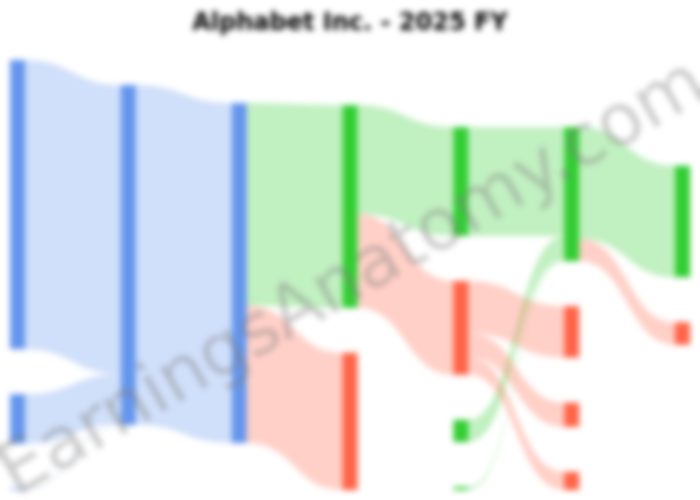
To visualize how Alphabet converts its massive top-line revenue into net profit, take a look at the flow diagram below. This chart tracks the money from revenue sources, through various costs and expenses, down to the final earnings.
The most striking operational highlight in this report is the maturation of Google Cloud. For years, Google chased market leaders Amazon (AWS) and Microsoft (Azure), often prioritizing growth over margins. That dynamic has shifted dramatically.
While Google Services (Search, YouTube, Android) remains the primary revenue driver with $342.7 billion, Google Cloud revenue grew to $58.7 billion, up significantly from $43.2 billion in 2024. More importantly, the segment's profitability has skyrocketed. Operating income for Cloud more than doubled, jumping from $6.1 billion in 2024 to $13.9 billion in 2025. This margin expansion signals that Google Cloud has transitioned from an investment-heavy challenger to a major profit engine for the conglomerate.
While revenues are up, the cost of securing Alphabet's future is rising sharply. The filing reveals an intense "arms race" to build out the technical infrastructure required for AI.
For those new to the term, CapEx generally refers to funds used to acquire, upgrade, and maintain physical assets. In Alphabet's case, this money is pouring into servers, data centers, and network equipment necessary to power modern AI workloads. While this spending does not hit the income statement immediately as an expense (it is depreciated over time), it represents a massive cash outlay.
Alphabet reported a Net Income of $132.2 billion, a robust 32% increase year-over-year. However, a deeper look at the Other Income (Expense), Net line item reveals that operational efficiency wasn't the only driver.
The company reported $29.8 billion in other income, a massive jump from $7.4 billion in 2024. This was primarily driven by $24.1 billion in net gains on equity securities, specifically unrealized gains on non-marketable securities. These are investments Alphabet holds in private companies. Because these are "unrealized" gains based on fair value adjustments, they boost Earnings Per Share (EPS) on paper but do not represent cash generated from selling ads or software.
Alphabet’s 2025 annual report depicts a company firing on all cylinders operationally. The core advertising business is growing, and the Cloud division has become a serious profit generator. However, the company is also locked in an expensive cycle of investment, spending nearly $100 billion in CapEx to secure its position in an AI-defined future.
Investors should also remain mindful of the regulatory backdrop cited in the filing. Alphabet faces ongoing antitrust proceedings in the US and new objections from the UK regarding its advertising technology. Financially, however, the company has demonstrated it has the immense capital required to weather legal challenges while funding the most capital-intensive technological shift in its history.
Last updated: February 5, 2026
Explore prior quarterly filings, historical revenue breakdowns, and earnings trends.
Alphabet Q3 2026 Earnings: Cloud Boom, Wiz Deal, and the $12B Paper Loss
Oct 30, 2026
Read
Alphabet Q2 2026: Cloud Strength Overshadowed by SpaceX Gains
Jul 23, 2026
Read
Alphabet Q1 2026: Cloud Growth, Wiz Acquisition, and a Massive Investment Gain
Apr 30, 2026
Read
Alphabet Q3 2025: Google Cloud Soars, EC Fine Hits Bottom Line
Oct 30, 2025
Read